Annaliese Martin is my name, and acting is my game. I currently studying a Bachelor of Acting and Performance through the University of Canberra in Brisbane, Australia, with the ambition of becoming a professional working actor within the Australian performance industry. I have recently commenced my second semester of second year within the three year course, and have been performing on the stage for several years prior. Although my training mainly revolves around stage acting, I am also interested in other mediums of performance such as film & screen acting, voice over work, script writing, dramaturgy and show production.
Interested in film and acting? Then Annie & Acting is the blog for you.
This blog was created for my Film & Screen unit for this semester, with posts focused on screen acting, film making, my personal thoughts and analysis of set films, as well as responses to class content. My aspirations for this unit include the ability to competently set-up and operate a camera, learning how to use a video editing program and effectively edit a video, and confidently perform in front of a camera. In regards to the Screen Studies module, I aim to develop sufficient knowledge on effective screen acting, various camera angles, and technicalities considered when shooting a scene, as well as come away with a catalogue of brilliant films for future reference.
So brew yourself a cup of tea, grab a bickie or two, and join me as we dive into the world of acting and film.
The story of friendship between two men serving life sentences in prison may sound rather dull as a movie plot. However, director Frank Darabont’s movie, The Shawshank Redemption, is far from dull.
Starring Tim Robbins as Andy Dufresne and Morgan Freeman as
Ellis ‘Red’ Redding, The Shawshank Redemption’ is a movie about time,
persistence and friendship; not qualities you would usually associate with a
‘prison’ movie but powerful all the same. When Andy Dufresne receives two life
sentences for a crime he didn’t commit, namely killing his wife and her lover,
he is sent to Shawshank, a maximum-security prison filled with hardened
criminals. For mild-mannered banker, Andy, this world could not be more removed
from his own life.
Tim Robbins and Morgan Freeman in ‘Shawshank Redemption’, 1994 (IMDB, 2019).
Following the three-act, linear structure of classic cinema
(Mueller & Williams, 2003), Darabont ignores the ‘show don’t tell’ mantra
of storytelling practitioners, preferencing voice-over to unfold the exposition
of the story from Red’s point of view. Many screenwriters, such as Robert McKee,
purport that voice-over is an “indolent practice” which “threatens the future
of our art” (McKee, 1997, pg. 344). However, “the voice-over helps focus the
story on one person, announcing this character is the centre of attention” (Mueller
& Williams, 2003, pg. 82), and while some might find it an intrusion, I
found it effective in humanizing the dehumanizing world of the prison system. As
Andy keeps his thoughts to himself, the first-person narration, delivered by Morgan
Freeman’s slow, easy drawl, is vital in drawing us into Andy’s world.
At 142 minutes long, and with clever work from
cinematographer, Roger Deakins, the film’s theme of hope rising out of despair,
develops slowly. A wide aerial shot, revealing the prison’s imposing fences,
isolation and thick walls; clearly establishes the oppression within,
“provid[ing] a basis for what is to come and initiat[ing] us into the
narrative” (Bordwell & Thompson, 2013, pg, 85). This is further enhanced
when Andy enters the prison; the low angle, point-of-view shot as the camera pans
up taking in the walls from ground to sky, creates a feeling of being engulfed.
Close up shots are used judiciously to build tension and character. Andy’s quiet,
reserved nature and steely determination is portrayed splendidly through
close-up, evoking our sympathy but at the same time revealing the man who was “a
closed book and hard to know” (Shawshank Redemption, 1994) that his wife
accused him of being. Finally, as Red and Andy embrace each other on the beach,
the shot gradually pulls back further and further until it is flying above them,
replicating the opening prison shot and creating the ultimate expression of
freedom.
Red and Andy reunite on the beach (Robberson, 2014).
According to Villarejo, low-key lighting “helps to gesture
toward the underworld, the shadowy world, uncertainty, fear, or evil”
(Villarejo, 2013, pg. 36). Although at times, the low-key lighting and grey
tones feel a little overplayed, it does work to create suspense and a gloomy, pervading
mood of fear and uncertainty. A good example of this is when Warden Norton is
questioning Tommy about Andy’s case. The low-key lighting casts a shadow across
his face, leaving it half in darkness and half in light, revealing that there
are two sides to his personality. Similarly, when Andy is sitting in his cell
with a rope, just before his escape, his half-lit face creates uncertainty; is
he going to “get busy living or get busy dying” (Shawshank Redemption, 1994). Much of the violence also takes place in
darkened corners or in the shadows, emphasizing the abusive nature of the
action. The heavy use of grey filters also provides an effective contrast for
the final scene. Andy and Red’s reunion on the beach swaps the grey, gloom of
the prison with high-key lighting and the blazing colour of blue water and sky,
representing freedom and redemption. One of my favourite scenes in the film
where lighting, sound and camera angles are used most effectively is Andy’s
escape. The synchronization of the lightening with his breaking open the
sewerage pipe, the torch light bouncing him in and out of darkness, the eye
view angle of the camera as he executes his “shitty pipe dream” (Shawshank
Redemption, 1994) and his moment of freedom bathed in light from above, an
aerial shot revealing his baptism in the rain, is uplifting and deeply
satisfying.
Andy embraces the rain (Moore, 2017).
The “continuity style” (Kolker, 1998, pg. 19) of the film
occurs through the editing which is smooth and unobtrusive; cross cutting, fade
outs, shot/reverse shots, over-the-shoulder shots and dissolve are all used
effectively to “create…what we need in order to understand the forward momentum
of the story” (Kolker, 2016, pg. 42). Cross cutting between the night of the
murder and Andy’s trial in the opening sequence, create both suspense and
exposition. Whereas, the use of dissolve in the opera scene as the camera pans,
in close up, from one prisoner’s face to the next, in conjunction with the
music, creates an uplifting feeling of hope. Intense conversations are pointed
through the use of over the shoulder shots.
While the acting is excellent, the constant twists and turns
throughout the film are heightened by the cinematography, directing and post
production choices. Combined with the voice-over narration, the message of the
film is clear: fear and man can imprison you but hope and friendship will set
you free.
References
Bordwell D., & Thompson K. (2013). Narrative Form. Film Art: An Introduction (10th edition). New York: McGraw-Hill. Accessed from University of Canberra, 6th November, 2019.
Kolker, R. (2016). Film Form and Culture. New York, NY:
Routledge.
Kolker, R. (1998). The Film Text and Film Form. The Oxford Guide to Film Studies. Ed. John Hill and Pamera Church Gibson. Oxford; Oxford UP. Pp. 11-23. Accessed University of Canberra, 6th November, 2019
Marvin, N. (Producer), & Darabont, F. (Director).
(1994). The Shawshank Redemption. [Motion Picture] United States: Castle
Rock Entertainment.
McKee, R. (1997). Story: Substance, Structure, Style and the
Principles of Screenwriting. New York, NY: Harper Collins. Pp. 334 – 345
Mueller, G. & Williams, J. (2003) Introducing Film: History and Form. Ways In: approaches to reading and writing about literature and film. New York, NY: McGraw Hill. Pp. 77-105. Accessed from University of Canberra, 6th November, 2019.
Shooting for the location scenes was
an educating and stimulating experience, as I have never had the opportunity to
engage in something like this before. I was excited leading up to the days of
the shoot, planning out my characters costume and considering ways in which Abbie
and I could perform. For my group, Reel Good Productions, lecturers
Mairi and Stephen offered their apartment for the location shoot. I appreciated
their generosity in letting us shoot there, and feel their stylish décor added a
lot to the film cuts.
I was unfortunately recovering from
a cough on the day of the shoot, so I had to leave the room several times to
cough out side so as to not disturb the filming process for Jayne and Peta. However,
I was able to have a go at doing sound for some of their scene, and found that
enjoyable. It is amazing how many things need to be taken into consideration
when doing a shoot, from the actors hitting their marks, to the camera being in
focus for each take, in conjunction with the boom mic catching all the audio
without being in shot. When Abbie and I were filming our scene, I discovered
that my biggest challenges lay in finding freshness in the lines for each take,
staying in the moment, and performing for the camera. I found it difficult not
to revert back to my stage acting training, and tried to maintain the intimacy
of the camera by being more naturalistic in my acting rather than performative.
I really appreciated Mairi’s direction of the scene in conjunction with her
engagement with us as actors. It was really helpful to be able to discuss the
scene with her between takes, involving the character’s objective, the desired
outcome for the next tape, and even the way in which the lines could be best delivered.
I discovered that actively conversing with the director enabled me to consider new
ways to deliver my lines in order to achieve my character’s objective, and
allowed me to focus on each take individually. As previously thought that the
director primarily liaised with the crew, this was a refreshing surprise that I
welcomed openly.
I believe that this experience has
provided me with a great deal of knowledge for my next location shoot, and
enabled me to comprehend elements of importance. For next time, I would like to
be more in tune with my relationship to the other character in the scene, as
well as more aware of the strategies my character utilizes to achieve their
objective. Additionally, I would like to focus more on playing to the character
than the stage, and will seek to continue to actively engage with the director.
Overall, it was a positive and enjoyable experience that I hope to engage in again.
“Costumes are the first impression that you have of the character before they open their mouth – it really does establish who they are”
Colleen Atwood
Assessment 2 of my Screen Acting Module involved my peers and I getting into groups of two, and choosing a duologue to perform from either a movie or Tv show. My partner and I, Abbie Anderson, selected a duologue from the film Miss You Already (2015), directed by Catherine Hardwicke. The two characters are Jess and Milly, played by me and Abbie respectively. Jess is dealing with Milly’s cancer diagnosis whilst also struggling with her own problems as she tries to become pregnant. In this scene, Jess feels betrayed that Milly lied about their trip away together, with Milly chasing down and having an affair with a bartender. The two argue, with a comment from Milly about Jess’s supposedly worry-free life causing Jess to reveal her pregnancy.
In order for a character’s costume to be believable, the costume designer “know ‘who’ the characters ‘are’ before they create a closet of clothes and accessories for the characters” (Landis, 2014, p.2). This requires the costume designer to study the screenplay so they are aware of the actions and characters within each scene, the time period they are in, and where they are located. The costume designer then meets with the director to discuss the desired overall outcome of the film, including “the overall colour palette and mood of the film” (Landis, 2014, p.2). The costume designer then moves on to the research part of the process, where they compile a selection of designs based on their findings. It is their desire for the costumes they create “blend into the story seamlessly and for the audience to be completely engaged in the story” (Landis, 2014, p.2).
“Costumes do not have to duplicate
the film’s period exactly, but they do need to look right to the audience” (Landis,
2014, p.3). This could also be said in regards to the location too, as there
may be certain parts of the script that can be adjusted to work within certain
limitations. For example, in the film Abbie and I chose our duologue from, the
scene takes place on a windy cliff face that over looks the sea. As a result,
the characters are dressed suitably for that location, adorning coats and
beanies to keep warm from the cool sea wind. However, as Abbie and I didn’t
have access to that kind of location, we adjusted the setting so that our interaction
took place in a kitchen. Interestingly, the overall tone of the scene was
slightly altered, as the kitchen presented a more intimate space to work in
rather than the open and expansive clifftops in the film. Instead of having an argument
in an open-air space, Abbie and I had a disagreement as we made dinner in the kitchen
of an Airbnb, we had booked to spend some quality time together.
Showing her shape: Drew lifted up her smock top to reveal the convincing baby bump she had hidden (DailyMail, 2014).
In addition to the setting being altered, so too were our ages. Both women in the film are in their late twenties to early thirties, with one of them having two kids. As Abbie and I are a bit younger than their supposed age, we changed it so that we were both in our early twenties, with Abbie only having one young child. Therefore, as both age and setting were both changed, so too were our costumes. As we were in the personal space of the Airbnb, costumes were kept casual but still neat. Costumes also aligned with the milder climate, as I wore a yellow peplum shirt with no sleeves and breathable black jeans. Although they weren’t in shot in the end, I also wore a pair of black docs, indicating a sense of youthfulness and style. The yellow shirt also allowed me to pop from the blue and white hues of the kitchen in the background, with my loose hair adding to the casualness of the situation. Moreover, the shirt itself is a little loose, with the peplum part aiding in concealing the pregnancy. I believe that my costume choice added to my performance, rather than restricting it. It enabled me to focus on authentically portraying my character, rather than causing me to be distracted by it.
Annaliese and Abbie location shoot (Cameron, 2019).
Overall, this experience with selecting a costume for a location shoot has enabled me to gain a better understanding of the need to consider the various elements that come with a choosing a costume. Not only must the costume accurately reflect the script and its circumstances, it must also be authentic to the character and not negatively influence an actor’s performance. The costume should enhance the performance and the scene’s overall authenticity rather than detracting from it, and fundamentally contribute to an audience’s engagement with the story.
“Nobody makes the films they want to make; they make the films they’re able to make”
Altman, as cited in Sawhill, 1994, p.47
Robert Altman’s 1992 film, The Player, presents a “brilliant dark comedy about the death of American film-making” (Zuckoff, 2009, p.404) and the world of film in Hollywood. Based on Michael Tolkin’s novel of the same name, The Player is described by Altman as farce that is a “very, very soft indictment of Hollywood, an unrealistic look at that arena” (Thompson, 2010, p.1991). He states the film is “all about greed, really, the biggest malady of our civilisation, and it was Hollywood as a metaphor for society” (Thompson, 2010, p.1991). A “story of murder and manipulation” (Eggert, 2016), Altman’s film exposes the true nature of Hollywood film-making, highlighting elements of corruption and just how far some will go to remain relevant in their career. Strap yourselves in, we’ve got a lot to cover.
Griffin Mill (Fine Line Features, 1992).
The film’s plot revolves around film executive, Griffin Mill, and his career at an unnamed production company. His days are filled with listening to pitches from eager screenwriters, green-lighting the ones he believes have the potential to be a successful film; “I can only say yes 12 times a year. Collectively we receive around 50, 000 [pitches]” (Altman, 1992). However, “Griffin is having trouble being a player” (Sawhill, 1994, p.47). His job is in jeopardy when hot-shot story executive, Larry Levy, transfers from Fox studios, possessing the potential to fill Mill’s position. To add his stress, Mill has also been receiving numerous death threats via postcards, deemed to be from a bitter screenwriter whose pitch he rejected. As a result of these occurrences, Mill “feels his career is riding on every decision. He’s freaked out and paranoid” (Sawhill, 1994, p.47).
He deduces that the postcards are from screenwriter, David Kahane, and resolves to meet with him and accept his pitch to stop the threats. After a call with Kahane’s wife, June Gudmundsdottir, Mill stages a run in with Kahane at the theater and the two go to a nearby bar. However, things go awry when an intoxicated Kahane snubs Mill’s screenwriting deal and provokes him about the insecurity of Mill’s job; “I can write. What can you do?!” (Altman, 1992). Mill is enraged and physically attacks Kahane in the bar’s car park, ultimately resulting in Kahane’s accidental drowning in a shallow puddle of water. However, the death threats continue, causing Mill to realise he has murdered an innocent man. The remainder of film follows Mill as he tries to secure his job at the studio, deal with a strained relationship, discover the author of the postcards, and ultimately, avoid getting caught for murder.
Griffin receives another death threat (Fine Line Features, 1992).
Although the film is recognised for its portrayal of Hollywood, Altman believes that “just a funny conceit, [as] that film, and the truth is much, much, worse” (Thompson, 2010, p.1991). Altman goes on to state that “although we did lift up a few rocks, Hollywood is much crueler and uglier and more calculating than you see in the film” (Thompson, 2010, p.1991). This statement is quite thought-provoking, as it “forces us to consider: if this is ‘soft’, then what must Hollywood really be like?” (Eggert, 2016). I believe that in most movies, Hollywood is portrayed as the land of dreams and fame, a world made up of sparkling celebrities and polished film-makers, a place where anyone has the potential to be a star.
However, this version of Hollywood is highly glamourized, often neglecting to expose the underlying truth of this world. Individual image is constantly manipulated, inflated, and marketed to appear as impressive as possible, pushing a sense of employability and promoting importance. Who you know is prioritised over what you know, with cut-throat competition present among all groups in Hollywood, including screenwriters, directors, and actors.
Griffin listens to another pitch (Fine Line Features, 1992).
However, despite the competition within these groups, each group relies on one another for success. Both the actor and screenwriter depend on the director for work, the screenwriter relies on talented actors to do their script justice, the director depends on the screenwriter for a usable script, and so on. Interestingly, “part of the reason executives hate writers is that they depend on them; the writers actually come up with ideas” (Sawhill, 1994, p. 48). Thus, although the executive is in the higher position, the writer actually holds all the power; without them, the executive is redundant. Therefore, although executives “have enormous egos…they are wildly insecure: they don’t really have anything that’s theirs” (Sawhill, 1994, p.49).
That being said, the group in possession of the highest power is, of course, the audience. In the end, they are the ones that witness the final product, and it is up to them whether or not they decide to indulge in it. Therefore, it is common for writers and directors to compromise their vision for the final product and sell-out in favour of pleasing the audience and doing well at the box office. Altman felt that writer-director Tom Oakley was an excellent example of this in the film, expressing that “that’s what all directors say! ‘I want this to be new’, ‘everything for art’, and then in the end we sell out” (Eggert, 2016).
Unfortunately, when it comes to taking a risk in film-making, a possible outcome is a costly film that returns a low profit. As a result, Hollywood resorts to examining previously successful films in order to uncover a “diamond-encrusted formula” (Eggert, 2016) that can be repeated for future films. Thus, it appears that film-making has been turned into a profit-focused business, rather than an industry that prioritises pure and creative artistic expression.
Griffin gets it all (Fine Line Features, 1992).
By the film’s conclusion, it is
apparent that Mill has become the ultimate player in several ways.
He played innocent to avoid
conviction.
He played Bonnie by cheating on her
with June.
He played June and kept her ignorant
of Bonnie and his role as Kahane’s murderer.
He played Larry Levey and ended up
with a promotion.
Scarily, I believe that we as the audience get so caught up throughout the movie in the hustle of Hollywood, that we almost forget that Mill has committed a serious crime. However, when we are reminded, we hold on to the hope that Mill will eventually be convicted for Kahane’s murder and face the consequences. Yet, as is always the case in Hollywood, we are provided with a happy ending. Mill gets away with it. He has won the game, and we have been played.
References
Brown, D.
& Tolkin, M. L. & Wechsler, N. (Producers), Altman, R. (Director).
(1992). The Player [Motion Picture]. US: Fine Line Features.
“Talent works only in the first film. But in the second film, an actor needs to show how much he knows about the craft. And that comes through training”
– Nawazuddin Siddiqui
As part of Assessment
1 for the Screen Acting Module my peers and I were required to source a 1-minute
monologue from a film or tv show. These were performed on-camera in class last
Friday with an allowance of up to three-takes, with students also rotating on
sound, camera, and crew roles. Though I had previously been recorded whilst performing
on stage, I had never performed exclusively to the camera until last week. Therefore,
although the experience was slightly daunting, I was curious to see how my training,
primarily in stage acting, would translate to film.
It was certainly
a different experience to perform for the camera as opposed to a live physical
audience, however I learned to enjoy the intimacy the camera brought and
discovered I could be more naturalistic in my acting. Furthermore, it is
interesting to note the difference between film and stage acting in terms of
conveying emotion. Unlike stage acting, where actors are trained expose their
emotions and let the audience in, it is more interesting in film to see a character
try to hide and control their true emotions. I believe this difference in
emotional expression correlates to the distance of the viewer, with a stage
actor required to clearly express their emotions in order to affect a tangible
audience sitting separate to the stage. However, the immediacy of the camera
allows film actors to be more subtle when expressing their feelings, with a
struggle for control evoking empathy in the viewer.
The recorded
monologues were viewed in this week’s Screen & TV class, with feedback
given to my fellow actors and myself from lecturers and directors Mairi Cameron
and Stephen Lance. It was helpful to listen to feedback given on other monologue
performances, as I was able to take notes on what did and didn’t work when
performing for the camera. Furthermore, I began to realise just how much the
camera really captures, from a subtle shift in expression, to a change in the
performers point of focus, even to a slight blink. In addition, after watching several
monologues I also began to understand just how important the eyes really are.
If an actor was disconnected from their character or didn’t fully grasp the
gravity of their dialogue, their eyes would be glazed over and unfocused, as if
they were somewhat vacant. However, it was evident when actor was connected and
emotionally invested in the character as there was a clear spark in their eyes;
focused and bright. Thus, I now understand that the eyes truly are where the
truth of the performance lies.
I was very apprehensive about watching a recording of myself as I was concerned with how my acting may have translated to film, as well as being self-conscious with how I may have looked. In addition, upon telling someone that I have a slight lisp they usually respond that it is barely noticeable or even non-existent. However, I was surprised to learn that my lisp was quite noticeable in the recording, especially in the beginning of my first and second take. I believe this is not only due to nerves but also the absence of a trained ‘performer’ voice which I often utilize on stage. Although I am unsure if my lisp was noticeable to anyone else, I feel this is something I need to work on in order to gain clarity of speech, especially in film. I also believe I need to avoid moving my head too much whilst talking, as well as work on maintaining eye contact and acting on impulse. That being said, I was pleased with my emotional connection to both the character and dialogue, and thought it transmuted well on the recording.
Overall, although it was an unnerving experience to perform for
the camera, I am excited to improve my film acting during rehearsals for the upcoming
duologue assessment. Furthermore, while I primarily view myself as a stage actor
for the moment, I hope that I will be able to continue my film training after
this unit so that one day I may perform in both in film and on-stage productions.
He’s Just Not That Into You poster (Kwapis, 2009).
GIGI: “Maybe his grandma died or maybe he lost my number or is out of town or got hit by a cab…” ALEX: “Or Maybe he is not interested in seeing you again.”
He’s Just Not That Into You, 2009.
Set in
Baltimore, Ken Kwapis’s film, He’s Just Not That Into You (2009),
follows the lives of nine people as they try to navigate their various romantic
problems. Although each has their own respective issue in love, their lives
intertwine with each character having a relationship with least one or two
other characters. Whether it’s an affair, a work relationship, a friendship, a marriage,
or a crush, each character’s desires and objectives impact one another through
the varying degrees of their relationships.
GigiPhillips (Kwapis, 2009).
Gigi is the protagonist of the main romantic storyline; a bubbly and cheerful thirty-something year old who is searching for her dream guy in order to achieve her happy ending. However, in Gigi’s own words, she gets “so focused on finding [her] happy ending [she] doesn’t learn how to read the signs” (Kwapis, 2009). She consistently misreads the signals displayed by guys who aren’t interested in her, misinterpreting a simple comment or even politeness as a sign of romance. She obsesses over every detail and overthinks every interaction with a guy she deems is partner-to-be: did he say it was just ‘nice’ to meet me, or did he say it was ‘really nice’ to meet me? How long should I wait for him to call before I should call him? He’s normally at the club on a Tuesday night, should I do a drive by to see if he’s there? Although Gigi means well, she is ditsy and naïve when pursing men, often failing to distinguish between the “ones who will stay, and the ones who will leave” (Kwapis, 2009). However, Gigi gradually becomes more perceptive throughout the film, learning to question a man’s intentions so as to uncover if they really are interested in her, or simply blowing her off.
Gigistarts to get wise. (Kwapis, 2009).
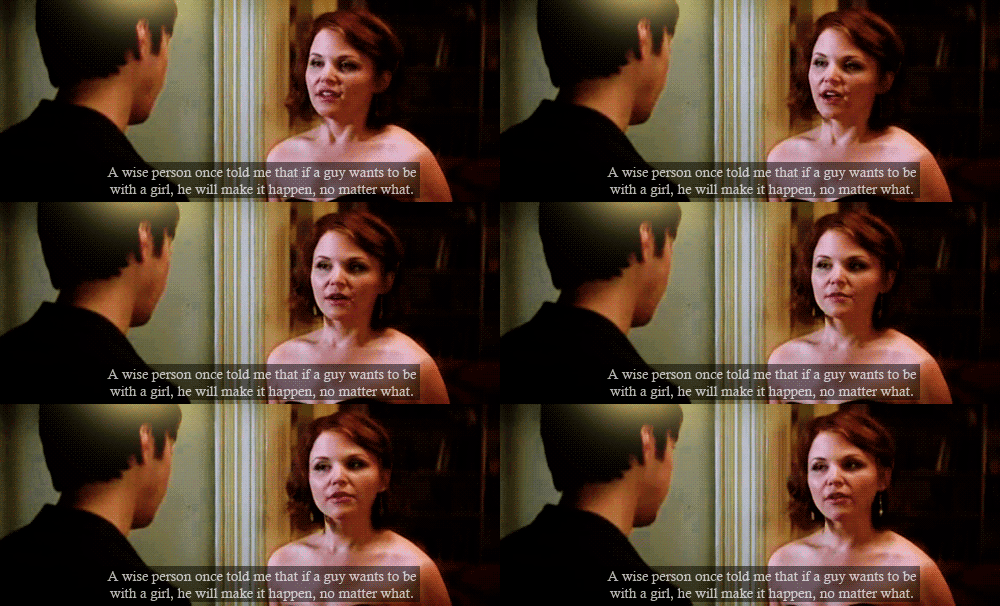
A pivotal moment of growth for Gigi occurs when, after throwing herself onto her male friend Alex, he reprimands her for misreading his relationship with her. He chastises her by stating that if a man wants to be with a woman, he will ask her out, going on to declare that women always over analyse a man’s intentions. This prompts a major revelation for Gigi, as she realises that she would rather put herself out there and learn from her mistakes then never even try, declaring to Alex, “I’d rather be like that than be like you” (Kwapis, 2009).
Gigi stands up to Alex (Kwapis, 2009).
Gigi’s final monologue is very introspective, as she reflects on all the “blunders and misread signals” she has gone through in her dating life, as well as “all the pain and embarrassment” (Kwapis, 2009) it has caused her. She allows herself to be vulnerable and expose her flaws by confiding in the audience all the times she has misread a guy’s intentions, causing her to act foolishly by pursuing and obsessing over someone who has no interest in her. In addition, Gigi also imparts the knowledge that she has gained from her experiences. She now realises that not every guy she meets will be ‘the one’, and that finding your dream guy is a process. Moreover, she reflects that you don’t necessarily need a guy to be happy, and that you can also be just as content with being on your own. Gigi has grown to recognise all the false information women are fed about finding a happy ending, “if a guy punches you, he likes you” (Kwapis, 2009), and now realises it is not the absolute truth.
Gigi displays her character growth (Kwapis, 2009).
Personally, Gigi’s
speech serves as a declaration to all women that we shouldn’t be afraid or ashamed
of going after our happy ending, what ever it may be. Whether the happy ending is
being with someone else, being by yourself, or being with your cat, keep pushing
for it and never give up hope that you will achieve it.
After all, you deserve someone who will call you back.
References
Juvonen, N.
& Disco, M. & Stroman, G. (Producers), & Kwapis, K. (Director). (2009).
He’s Just Not That Into You [Motion Picture]. US: Flower Films.
Maggie Cheung in the film poster for In the Mood for Love (Kar-wai, 2001).
Mise-en-scene
and the arrangement of its elements determine both the nature of the view
presented and the way in which the audience is invited to see it. Elements of
lighting, costume, décor, props and actors and their relationship with the
camera through framing and camera movement, govern our access to the action and
determines our understanding of the scene. Therefore, as our experience of the
films events is determined by the nature of the view presented, one must take
into consideration the expressive power of the variables in Mise-en-scene. The
expressive style of Wong Kar-Wai’s film In the Mood for Love (2001)
enhances feeling and atmosphere whilst displaying a visual insight into the
character’s inner lives through elements such as space, lighting, colour and
costume.
An intimate moment shared between Su Li-zhen and Cho Mo-wan (Kar-wai, 2001).
In his book,
Mise-En-Scene Film Style and Interpretation, John Gibbs highlights the
importance of space as ‘a vital expressive element’ (Gibbs, 32). This is
exemplified in a scene between Mrs Chang and Mr Chow when the space between
them determines the intimacy of the scene. In close proximity, with deep space
blocking positioning Mrs Chang closer to the camera, the spatial choices not
only allow for audience analysis of facial expressions but also expresses the
nature of their relationship. Mrs Chang’s costume is simple yet elegant; the
red of her dress hinting at the colour of passion. The accompaniment of this
subtle ardour along with intimate positioning leads the audience to believe
that something might occur between the character’s in regards to romance. The
softness of the lighting exposes the vulnerability and sensitivity of the
scene, with low-lighting indicating a sense of deviance.
Su Li-zhen’s 21 Cheongsams worn throughout the movie (Kar-wai, 2001).
Lighting
plays a pivotal role in exposing the secrecy of their relationship. With their
dalliances taking place at night, sharp, almost artificial, lighting throws
shadows on their faces highlighting every change of emotion and uncertainty in
their expressions; their bodies are often presented in sharp silhouette adding
to the air of mystery and intrigue. The manipulation of the lighting along with
close up camera angles invite us to believe their relationship may go further,
although by the film’s end this is revealed not to be the case.
Su Li-zhen and Cho Mo-wan (Kar-wai, 2001).
The position
of the camera also plays a vital role in directing our access to the action.
“As what is in the frame is only a selective view, the position of the camera
is going to determine our understanding of the scene” (Gibbs, 34). Suspense, fear, intrigue is generated through
the clever use of camera angles. Gibbs states that “how we experience a given
set of events is going to be profoundly affected by the nature of the view, or
views, with which we are presented” (Gibbs, 34). Close up shots on Mrs Chang
with Chow staring intently at her in a blurred field of vision behind her creates
tension and a sense of foreboding. In the opening scene, the camera is
positioned outside the window, partially obstructing the audience’s view. At
other times, the camera follows the characters from behind at eye level, or
observes them from across the street. This gives the audience a sense of
voyeurism, as if they are peeking in on the character’s lives, secretly
observing character interaction.
Maggie Cheung in Faa yeung nin wa (2000) (Kar-wai 2001)
Overall, Wong
Kar-wai’s film In the Mood for Love (2001), is a fantastic example of how
form and content can work together to develop depth within a film. Subtle manipulation
of the mise-en-scene, lighting, costume, and camera angles reveal both character
and scene subtext, thus heightening intrigue, and creating an engaging
experience.
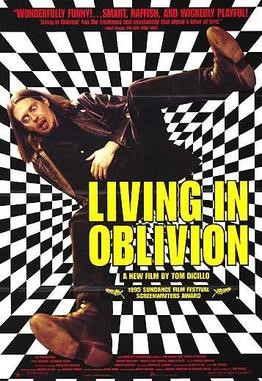
Steve Buscemi in the theatrical release poster for Living in Oblivion (Sony Pictures Classics, 1995).
Ask any
director and I’m sure they’ll tell you that film making can be a painstaking
process, especially one on a low-budget. Director Nick Reve, played by Steve
Buscemi, unfortunately knows this all too well in Tom DiCillo’s 1995 film, Living
in Oblivion, as he struggles to coordinate cast and crew in order to shoot
the perfect scene. Dark and satirical, this three-part comedy offers a glimpse
of what can really go on behind the scenes of your favourite movie, and how it
effects the final cut.
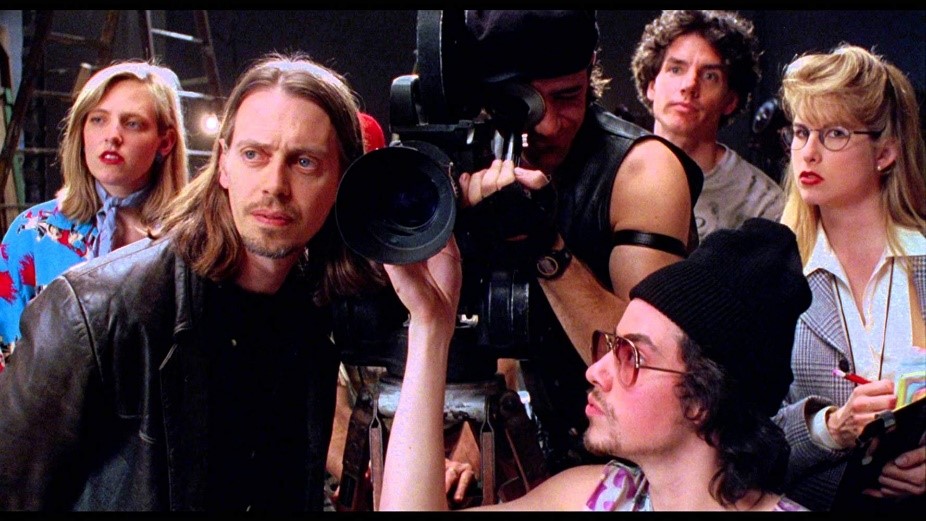
Steve Buscemi, Dermot Mulroney, Ryan Bowker, Kevin Corrigan, Hilary Gilford, and Danielle von Zerneck in Living in Oblivion (Sony Pictures Classics, 1995).
The film’s characters are realistic through their interaction with one another, as well as their setting and costuming. However, the given circumstances cause the stakes to be heightened, as they frantically try to stay on schedule with filming all while dealing with a low budget. As a result, character archetypes emerge in the frenzy, with a specific trope underlying each person’s behaviour:
Nick Reve – The tired and overworked director, struggling to keep the peace on set in order to reach their vision, who is “accommodating, supportive, non-judgmental, practical and hard-working” (Montgomery, 2018).
Chad Palomino – The deluded and narcissistic pretty boy who has zero talent, yet is so entitled that he believes he is never in the wrong. He is so “self-absorbed to the point that [he] consistently prioritize[s] [his] own desires at others’ expense” (TvTropes, 2019).
Nicole – The
beautiful woman who is “friendly, psychologically well-balanced, [and] morally
average” (TvTropes, 2019), striving to establish a career in a ruthless
industry, all while trying to keep her crush on her boss under wraps.
Wolf – The
tough guy with a sensitive side who is nice to his love interest yet still
finishes last, resulting in “low-key yearning” (TvTropes, 2019).
Wanda – The assertive
woman who is dedicated to her job, yet cannot balance love her career at the
same time, “which inevitably brings her a lot of heartbreaks” (Black, 2017).
Cora – The
eccentric old woman who is “oddly endearing…naïve, innocent and sarcasm-blind”
(TvTropes, 2019) and eventually saves the day.
Nick, Chad and Nicole (Sony Pictures Classics, 1995).
Throughout the movie, it becomes evident that the chemistry between the characters on screen is affected by their relationships off camera. In the second sequence, Nicole dreams about a love confession scene between her character, Ellen, and Chad’s character, Damian. However, Nicole struggles to truthfully convey a sense of love and intimacy between their characters on camera, as a result of Chad’s true personality off screen. He berates Nicole’s acting, continuously goes off script, and demands the director follow his blocking, thereby causing the on-screen relationship to suffer. Furthermore, it is brought to our attention that relationships between crew members can also affect the quality of their work and create tension on set. Camera man and cinematographer, Wolf, becomes upset and withdrawn when the First Assistant Director, Wanda, breaks up with him during the third sequence. As a result, Wolf neglects his job and leaves the camera unattended, preferring to sulk on set, with the possibility of further delaying production.
Wanda and Wolf (Sony Pictures Classics, 1995).
The frustration felt by the characters is palpable, with the audience suffering with them as scenes are redone over and over again. However, it is through the movie’s structure that the viewer can truly experience the reality of making a movie, as well as how obstacles on set can affect the final outcome of the product. Watching this film is like making a movie, you never know how many times something will be repeated or when it a sequence will be complete; you’re always living in oblivion.
Griffiths,
M. (Producer), Viscidi, M. (Producer), & DiCillo, T. (Director). (1995). Living
in Oblivion [Motion Picture]. United States: Sony Pictures Classics.
Sony
Pictures Classics. (1995). Steve Buscemi, Dermot Mulroney, Ryan Bowker, Kevin
Corrigan, Hilary Gilford, and Danielle von Zerneck {Image]. In T. DiCillo. Living
in Oblivion. Retrieved from, https://www.imdb.com/title/tt0113677/mediaviewer/rm4216334336




 Annie & Acting